
Environment TCFD Initiatives
TCFD Initiatives and Information Disclosure
We regard climate change as one of the most important material issues and incorporate it into our management strategies to promote climate change countermeasures.
In March 2021, our Group obtained certification for the 2030 WB 2.0°C goal*1 from the Science Based Targets initiative (SBTi) for our greenhouse gas emissions reduction goals. However, under our 2026 Medium-Term Management Plan, we have raised our reduction goals to the 1.5°C level.*2 In line with this, in June 2024, we received certification from the SBTi for the upgrade of our goal to the 1.5°C goal and the 2050 net-zero goal.
The Group will achieve its goals for which we made public commitments through various measures as an Environment-Creator® to help realize a carbon-neutral and net-zero society.
We have been disclosing progress on these initiatives in this Corporate Report to date. Going forward, we will continue to sequentially enhance the content with reference to the SSBJ standards.
- Annual reduction target: 2.5%
- Annual reduction target: 4.2%
Governance
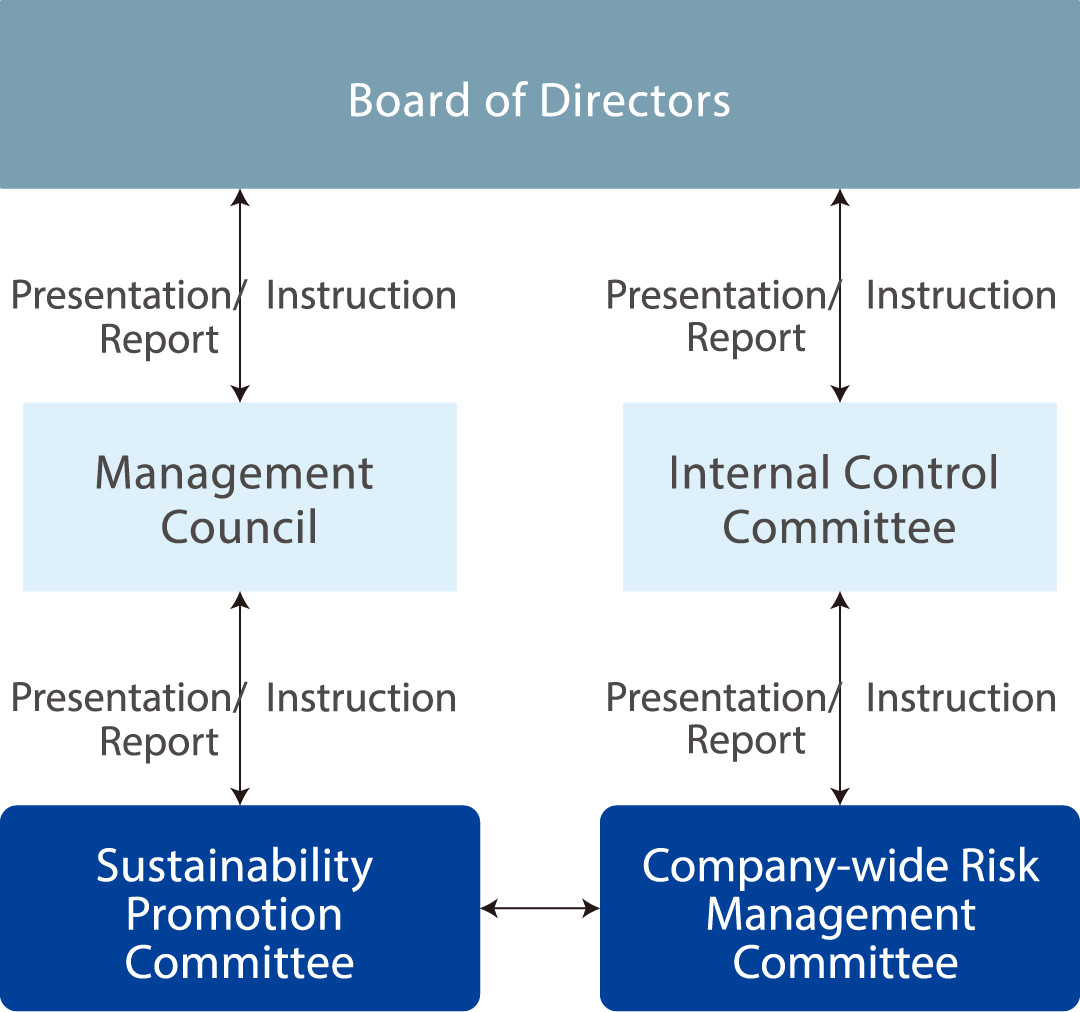
In April 2024, we established the Sustainability Promotion Committee to address climate-related initiatives more from a business perspective, linking them to our Purpose and Long-Term Vision for 2040, which was formulated in FY2023, and to the strategies presented in the 2026 Medium-Term Management Plan, which serves as the first step.
The Sustainability Promotion Committee works to clarify both the process and the anticipated financial impacts, recognizing that addressing the sustainability issues identified as material for our Group will lead to medium- to long-term corporate value enhancement. We have shifted to a system in which our headquarters’ chief executive officers and general managers discuss the Group’s overall medium- to long-term goals and immediate implementation measures, and then submit and report the results to the Management Council and the Board of Directors.
In FY2024, the Committee met seven times, focusing primarily on themes for resolving climate-related issues, which were incorporated into the FY2025 management plan via the Management Council.
Results in FY2024
| Meeting | Main agenda items | Details |
|---|---|---|
| 1st | Sharing of issues and measure directions | Clarification of strategies that contribute to achieving sustainability goals and enhancing corporate value |
| 2nd | Results and forecast of CO2 emissions | Sharing of FY2023 CO2 emission results and formulation of an action plan to achieve SBT goals |
| 3rd | Scope 3 emissions reduction plan | Detailing and disclosure of specific reduction measures for business activities |
| 4th | Review of TCFD disclosure content | Executive-side review of TCFD disclosure content in preparation for submission to the Management Council |
| 5th | Scope 1 and 2 emissions reduction plan | Policy for activities to reduce Scope 1 and 2 emissions and consideration of the use of carbon offsets |
| 6th | Examination of activities that contribute to emissions reduction | Evaluation of the content and validity of activities that contribute to CO2 emission reductions through business operations |
| 7th | Clarification of activity roles and responsibilities | Formulation of the organizational system and consideration of location-by-location goals for activities contributing to Scope 1, 2, and 3 emission reductions |
Plans for FY2025
| Meeting body | Members | Frequency | Role |
|---|---|---|---|
| Board of Directors | Directors | 4 times per year |
|
| Management Council | Directors and General Managers of main office and branches | 4 times per year |
|
| Sustainability Promotion Committee | General Managers of head office General Managers of main office and branches, etc. |
8 times per year, including 4 on climate-related topics |
|
| Company-wide Risk Management Committee | General Managers of head office General Managers of main office and branches, etc. |
5 times per year |
|
Strategy
The potential business impact assessments and measures for the identified risks and opportunities are as follows. In formulating these measures, possible adverse effects on biodiversity and other factors have been taken into account.
Business impacts and response measures for climate-related risks (transition risks)
| Type | Risks | Business impacts*1 1.5℃ scenario |
Period*2 | Summary of measures |
|---|---|---|---|---|
| Policies and regulations | Increase in operational costs due to the introduction of a carbon tax |
Medium | Medium-term |
|
| Increase in procurement costs due to the introduction of a carbon tax | Large | Medium-term |
|
|
| Technologies | Decrease in orders received due to delay in technological development related to energy conservation (existing field) | Large | Short- to medium-term |
|
| Loss of revenue opportunities due to delays and increased investment costs of the development of decarbonization-related technologies and services as well as inadequate response to decarbonization-related market needs (new field) | Medium- to long-term |
|
||
| Reputation | Decrease in corporate value due to inadequate response and disclosure information for climate-related issues | Large | Medium-term |
|
Business impacts of climate-related opportunities and response measures
| Type | Opportunities | Business impacts*1 | Period*2 | Summary of measures |
|---|---|---|---|---|
| Resource efficiency | Reduction of operating costs and increase in productivity by transforming the construction process | Large | Medium- to long-term |
|
| Products and services |
Increase in revenue opportunities due to increased corporate equipment replacement needs as a result of developments in energy conservation promotion policies and regulations | Large | Medium- to long-term |
|
| Increase in sales from installation of products that contribute to reducing environmental impact (Swirling Induction Type TAKASAGO HVAC System (SWIT®), PMAC products, etc.) | ||||
| Market | Development of new markets by introducing new services and developing new technologies such as green energy supply equipment, including our water electrolysis hydrogen production system (Hydro Creator®) | Large | Medium- to long-term |
|
| Creation of advantageous financing opportunities such as green bonds | Large | Medium- to long-term | Consideration of the use, if needed, for above investment
|
- Business impact is classified as “small,” “medium,” or “large” based on a qualitative assessment of the estimated financial impact (costs: up to 100 million yen for “small,” 100 million to three billion yen for “medium,” and three billion yen or more for “large;” revenues: up to two billion yen for “small,” two billion to 30 billion yen for “medium,” and 30 billion yen or more for “large”) (the cost and revenue thresholds for “large” are based on the TSE’s timely disclosure standards).
- Short-term refers to one year (aligned with the annual management plan), medium-term refers to 3 to 10 years (aligned with the Medium-Term Management Plan), and long-term refers to over 10 years (aligned with the Long-Term Vision).
Our Group’s 2050 net zero emissions transition plan
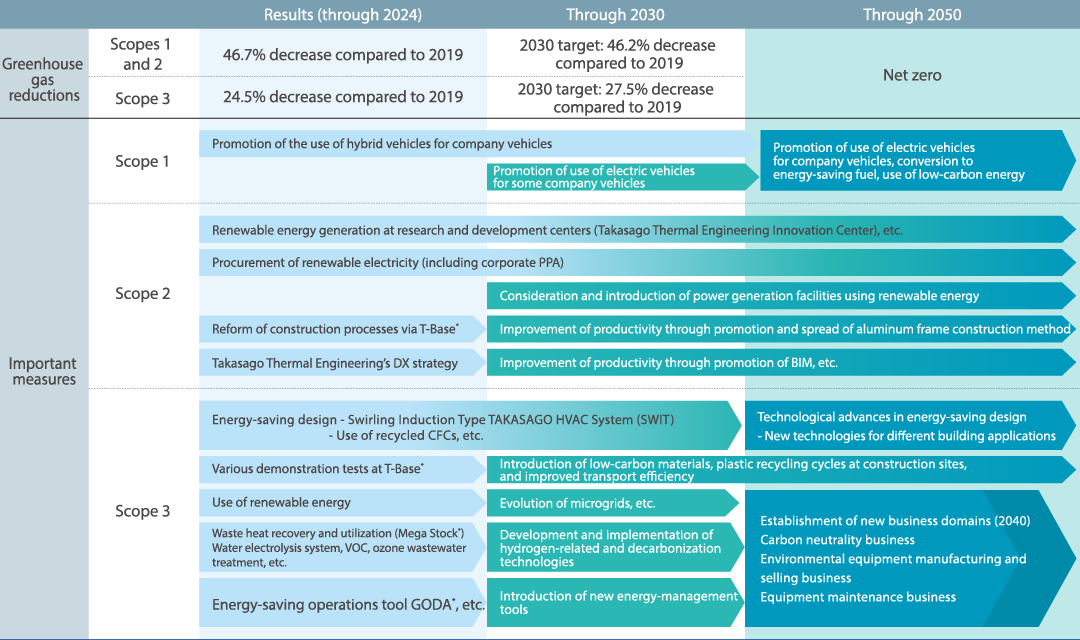
From the perspective of ensuring the resilience of our strategies under any scenario, the Group has formulated a transition plan toward net zero emissions in 2050. While appropriately avoiding risks, we will steadily capture business opportunities and work over the medium to long term toward the Takasago Thermal Engineering Group’s Long-Term Vision for 2040 goal of ordinary income exceeding 40 billion yen.
Risk management
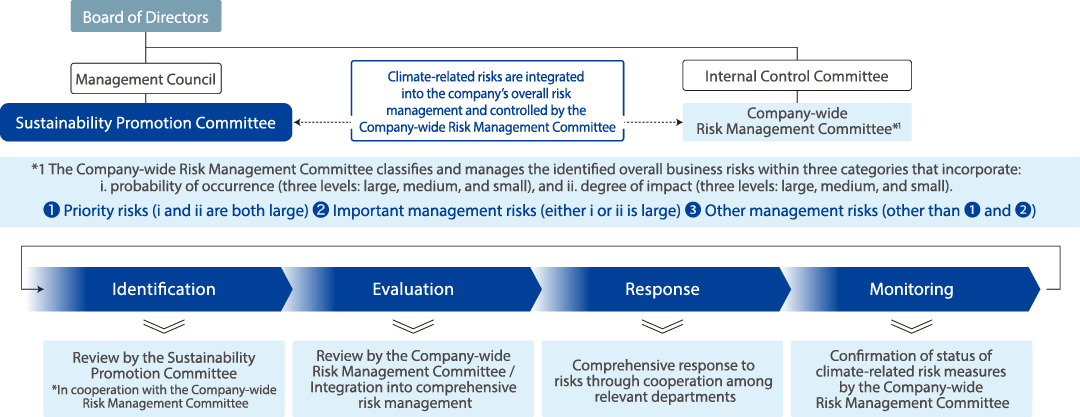
The Group classifies risks into three levels based on probability of occurrence and impact, and evaluates and decides them through the Company-wide Risk Management Committee. These risks are monitored by the Board of Directors via the Internal Control Committee, with climate-related risks also subject to integrated management. In FY2024, we implemented company-wide risk control after identifying five risks as priority risks, including compliance with labor regulations, overruns of construction capacity, and human capital deterioration. Climate-related risks are integrated into this framework and managed together with other business risks.
Targets and goals
(1) Indicators for greenhouse gas (GHG) emissions reduction
Our Group has set the GHG emissions reduction rate as a KGI in the Medium-Term Management Plan, aiming to reduce emissions across Scopes 1, 2, and 3. We have obtained SBTi certification for the 1.5°C target, and by the end of FY2024 achieved reductions of 47.0% in Scope 1, 4.6% (non-consolidated) in Scope 3, and 1.0% (consolidated). As KPIs, we have set targets of installing 5,000 kW of green-energy facilities and achieving annual energy-saving proposals/orders totaling 15,000 t-CO2 by FY2026. Going forward, we will promote EV adoption, renewable energy procurement, and use of low-carbon materials, while also contributing to emissions reduction at customer facilities. Through these efforts, we aim to help reduce society’s overall GHG emissions.
Actual GHG emissions (Scopes 1 and 2)
|
Consolidated
|
Target scope | FY2019 | FY2022 | FY2023 | FY2024 | Compared to FY2019 |
|---|---|---|---|---|---|---|
| Scopes 1 and 2 | 11,961 | 10,727 | 10,490 | 9,032 | 24.4% reduction | |
| Scope 1 | 4,794 | 5,491 | 4,689 | 3,926 | 18.1% reduction | |
| Scope 2 | 7,167 | 5,236 | 5,801 | 5,105 | 28.7% reduction |
|
Non-consolidated
|
Target scope | FY2019 | FY2022 | FY2023 | FY2024 | Compared to FY2019 |
|---|---|---|---|---|---|---|
| Scopes 1 and 2 | 7,582 | 5,295 | 5,339 | 4,013 | 47.0% reduction | |
| Scope 1 | 3,106 | 2,801 | 2,564 | 1,755 | 43.4% reduction | |
| Scope 2 | 4,476 | 2,494 | 2,775 | 2,258 | 49.5% reduction |
Scope 2 figures are based on the market-based method
Actual GHG emissions (Scope 3)
|
Consolidated
|
Target scope | FY2019 | FY2022 | FY2023 | FY2024 | Compared to FY2019 |
|---|---|---|---|---|---|---|
| Scope 3 | 6,129,555 | 6,294,255 | 7,007,529 | 6,064,153 | 1.0% reduction |
|
Non-consolidated
|
Target scope | FY2019 | FY2022 | FY2023 | FY2024 | Compared to FY2019 |
|---|---|---|---|---|---|---|
| Scope 3 | 4,874,234 | 4,753,188 | 4,892,550 | 4,647,493 | 4.6% reduction |
(2) Assets and businesses relevant to climate-related risks and opportunities
With regard to carbon taxes—one of the major climate-related risks—if future strengthening of regulations leads to higher tax rates, and assuming taxation based on our FY2024 GHG emissions, the estimated financial impact would be about 155 million yen.
(3) Investments relevant to climate-related risks
Within the current Medium-Term Management Plan period (2023–2026), our Group plans to make growth investments totaling more than 90 billion yen. These growth investments are intended to enable business transformation for our Group as an Environment-CreatorTM, with a significant portion dedicated to addressing climate-related risks and opportunities.
(4) Internal carbon pricing
When considering future climate-related investments, we are examining the introduction of internal carbon pricing as one of the decision criteria. The set price will be determined with reference to future carbon-price projections published by the IEA.
(5) Incorporation of climate-related indicators into executive remuneration
For executive remuneration, we have established Scope 1 and 2 GHG emissions reduction targets as non-financial indicators for determining performance-linked stock compensation, thereby clarifying the responsibility of executive directors for addressing climate-related social issues. For details, please refer to P. 86.
Learn about Our Other ESG Initiatives


- Top
- Sustainability
- Environment
- TCFD Initiatives