
Global Talent Dialogue between the President and Foreign National Employees
Since his appointment, President Kojima has been actively engaging in dialogue with a wide range of employees in order to “share his thoughts on a daily basis and change management.” He had very high expectations for the talk session with foreign national employees, which was planned by the global talent workshop as a part of the working activities for diversity promotion. Three foreign-national employees of different nationalities and positions in the Company took part in the talk session. So, what did President Kojima and the three participants talk about?!

Participants: From the left in the photo
Zhang Xing Hui, Ruan Jie, President Kojima, Pham Toan Thang
(Departments and positions are current as of January 2023)
Promoting diversity is essential for corporate growth

President Kojima: I have been looking forward to the opportunity to speak to everyone here today. First, please briefly introduce yourself and tell us about your work duties.
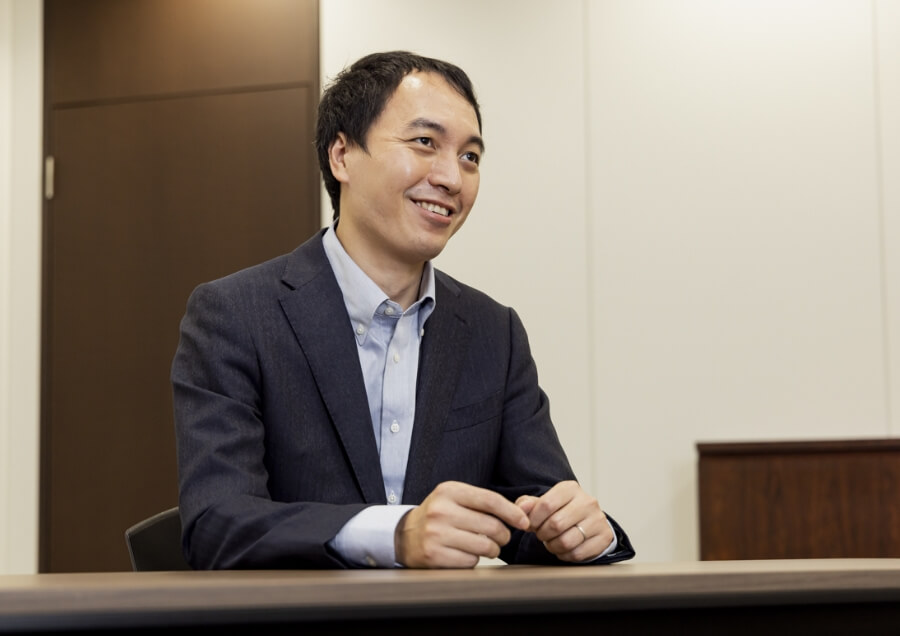
Zhang: I am Zhang Xing Hui of Section 2 of the Technical Engineering Division 2 of the Nagoya Branch. I wanted to join Takasago after majoring in air conditioning equipment at a graduate school in Japan. This is my 12th year at the Company. I am currently heading a district office and working on proposals and plans for the renewal of buildings, as well as managing each construction group. In my 4th year at the Company, I was in charge of renovation and new construction of heat sources in hospital buildings. In my 5th year, I was involved in the construction of clean rooms in semiconductor factories at an internal JV. In my 6th year, I became an on-site foreman for the first time, and during my 7th to 11th years at the Company, I was involved in the new construction of three commercial facilities.

Ruan: I am Ruan Jie of the Technical Section of the Saitama Office in the Kanto-Koshinetsu Branch. I researched air pollution at a graduate school in Japan. This is my 5th year at the Company. So far, I have been involved in the new construction of complexes and office buildings, and the renovation of warehouses and factories. I have learnt and experienced many things through my work here.

Thang: I am Pham Toan Thang of Section 1 of the Technical Engineering Division 2 of the Nagoya Branch. I studied hydrodynamics at a university in Japan. This is my 2nd year at the Company. I have mainly been in charge of on-site operations. My work involves taking pictures of construction and organizing the photos, preparing documents, revising blueprints, and other tasks.
President Kojima: All of you are working hard on site. Zhang-san, you are the only one of the foreign-national employees to be in a management position of deputy manager. What was the background to reaching this position?
Zhang: In addition to my own efforts, which were evaluated and followed up by my superiors as required, each time I produced results I was given the next chance to advance my career; I think that was a major factor in reaching the position of deputy manager. In my case, during the first four years at the Company, I was working on site with just the on-site foreman. So it was just the two of us who had to deal with all types of tasks and issues. However, I approached that situation with a positive attitude, and kept moving forward and learning all that I could. When I first started working as an on-site foreman, I was in charge of hiring temporary workers from staffing agencies, selecting partner companies, and dealing with design offices. There were troubles at times, but the manager would accompany me when I visited clients to report on the situation, and give me advice on how to write reports. So with this support, I was able to overcome any difficulties I faced. Then in my 8th year at the Company, when I successfully completed my first new construction project, I was able to take an examination for promotion.
President Kojima: What are the things you find difficult in your work?
Ruan: At first, I couldn’t understand what the craftspeople were talking about. I was utterly confused. I can converse in Japanese at a level that is sufficient for daily life; but the craftspeople talk using lots of technical terminology, which sounded like a different language to me.
President Kojima: So, how did you overcome that difficulty?
Ruan: The craftspeople started speaking in easy-to-understand Japanese, and carefully and patiently explained each of the terms they used. It took time, but I didn’t give up and kept persevering in the face of those difficulties. I was also supported and helped a lot by the people around me, including the on-site foreman and manager, and members of the management division. If there is something that is troubling me, I don’t keep it to myself; I talk about it with people I can trust.
Thang: I also struggled to understand what the craftspeople were talking about, but my superiors and senior colleagues helped me by kindly explaining the terminology the craftspeople were using. There was a particularly helpful senior colleague, who I often talked to when I had troubles and concerns.
President Kojima: It is important for all employees to have an atmosphere that makes it easy to talk to colleagues and receive support and advice. We will continue to actively create a friendly workplace culture that facilitates this. What about the enjoyable and happy aspects of your work?
Ruan: Even though I might be struggling, the moment when each side understands each other is a special kind of happiness. Since FY2021, the Kanto-Koshinetsu Branch has been holding “K (Kanshinetsu) Culture” lectures on the cultures of foreign countries, with the aim of promoting diversity in the workplace. I am also taking part in these lectures as a Chinese language lecturer. It is a really rewarding experience, and it makes me feel like I am helping to deepen mutual understanding among employees.
Having an international perspective is essential for corporate growth
President Kojima: In 2023, Takasago will celebrate the 100th anniversary of our founding. Using the air conditioning technologies we have accumulated so far, we are aiming to create not only comfortable spatial environments, but also contribute to environmental conservation on a global scale and as an Environment-Creator™. I believe that having diverse perspectives is essential to making dramatic leaps forward on a global scale.
Zhang: What expectations do you have for foreign-national employees, including those for the future?
President Kojima: The other day, I went on a tour of Thai Takasago. There are 390 employees working at Thai Takasago. This includes 10 assigned employees from Japan, and 10 Japanese employees who were hired locally. The president of Thai Takasago is an assigned employee from Japan. Our aim is to ensure a sincere understanding of and smooth communication with local employees and customers. However, so that we can develop our business in Thailand even further, in the future I would like Thai Takasago to be headed by a local employee from Thailand, who really understands the situation in Japan as well. To achieve that, we need to also train and develop locally on-site foremen, while growing the business there. So my expectations for foreign-national employees who have acquired experience in Japan is for them to serve as bridges of communication between Japan and our overseas subsidiaries. Currently there are 37 foreign-national employees working at Takasago, which is 1.7% of all employees. Going forward, we will make clearer the career path for global talent at the Company. Zhang-san, I hope you will become a role model for other foreign-national employees.
Thang: I would like to work at Takasago Vietnam in the future. I think most of the customers of Takasago Vietnam are Japanese-affiliated companies. However, in the future, I would like to work in Vietnam and help expand the business to include orders from the government and Vietnamese companies.
President Kojima: That’s exactly right. And what we need to achieve that, as I mentioned before, is local talent who also understand the situation in Japan and our technologies, and who can head our overseas subsidiaries. I will visit Takasago Vietnam next, so I will take a close look at the situation there. I am always thinking of the next areas where we can expand our business. When considering these areas, I focus on the countries where our carbon neutral technologies can be of use. I also need accurate information about the situation in those countries where we can expand our business. So this is another area where we can use the skills and knowledge of foreign national employees.
Ruan: I would like to work in the International Division. I want to help connect Japan with China and other overseas bases, and contribute to developing our overseas business.
Having a shared recognition of problems is an issue for the entire company
President Kojima: Are there any things you have noticed about the Company while working here?
Thang: In terms of the work “environment,” I think it is also important to have a comfortable on-site office. For example, it would be good to have an area where workers can relax and chairs that we can use when taking a break.
President Kojima: That is an important point, and an issue for the entire company. We have to change the preconceptions at on-site offices about those things (prefabrications, simple surveys, etc.) To start changing things, we are holding an On-Site Work Improvement Grand Prix (G-1GP) as work styles reform initiative. For example, instead or renting steel tables and chairs, we will rent or buy worker-friendly and comfortable equipment, and encourage efforts to create a better work environment at on-site offices.
Ruan: Of course, language problems are also a major issue. Particularly during the initial on-site training, it would be reassuring to be assigned to places where there are senior colleagues who are foreign national employees, and if possible, from the same country.
President Kojima: It is tough for anyone to be alone in an unfamiliar place, right from the start. That is why we also try to assign Japanese employees to offices near their hometown or alma mater university, as their first post after joining the Company. We are trying to create an environment that is as reassuring as possible for foreign national employees as well.
Thang: There is a lot of technical terminology that is used; so it would be reassuring to have a native speaker of our own language explain the terminology to us during training. This would also help us to understand the terminology at the same pace as Japanese employees.
President Kojima: So, you are saying it would be good to have a mentor system among foreign national employees. Thank you for your suggestion.
Respecting other cultures is showing consideration to all employees
President Kojima: Is there anything else you would like to have put in place at the Company?
Ruan: Each country has its own important events, so it would be great if foreign-national employees could take a holiday on those days.
President Kojima: Yes, I have already heard such a request, and from April 2023 we will put in place a system for that. Specifically, for foreign-national employees, we will set up a new home-leave holiday in addition to the usual paid holidays. This system allows employees from China and Vietnam to go home and spend time with their families during the Lunar New Year. Showing consideration to other cultures is not special treatment; it is a natural and necessary action in order to acknowledge diversity. So in that sense, we also want to set up a similar system for assigned employees from Japan who are working at overseas subsidiaries. The first step to true diversity and inclusion is to pay close attention to the circumstances of each individual, regardless of their nationality and attributes. We are now in a time of change. Let’s keep developing today’s dialogue so that we can be a company that employees are even prouder to work at and customers choose even more!
All together: Let’s all do our best!


Profile of participants

Pham Toan Thang
Nationality: Vietnam Hobby: Reading Japanese novels (Natsume Soseki, etc.) and manga. Favorite food: Soy sauce ramen
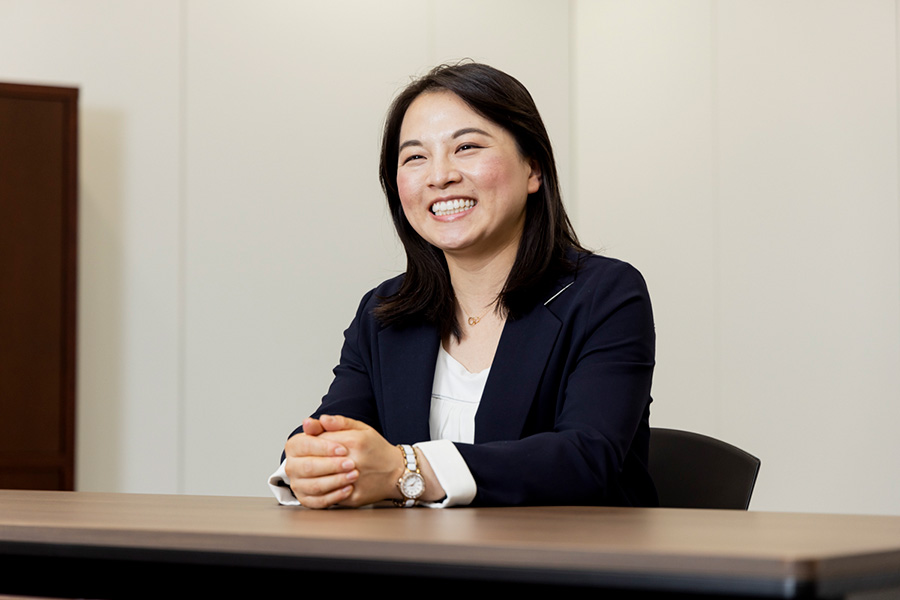
Ruan Jie
Nationality: China On her days off, she likes to travel and play sports. What surprised her about being in Japan: Many people smiling and saying “thank you” Favorite food: Hokkaido pumpkin
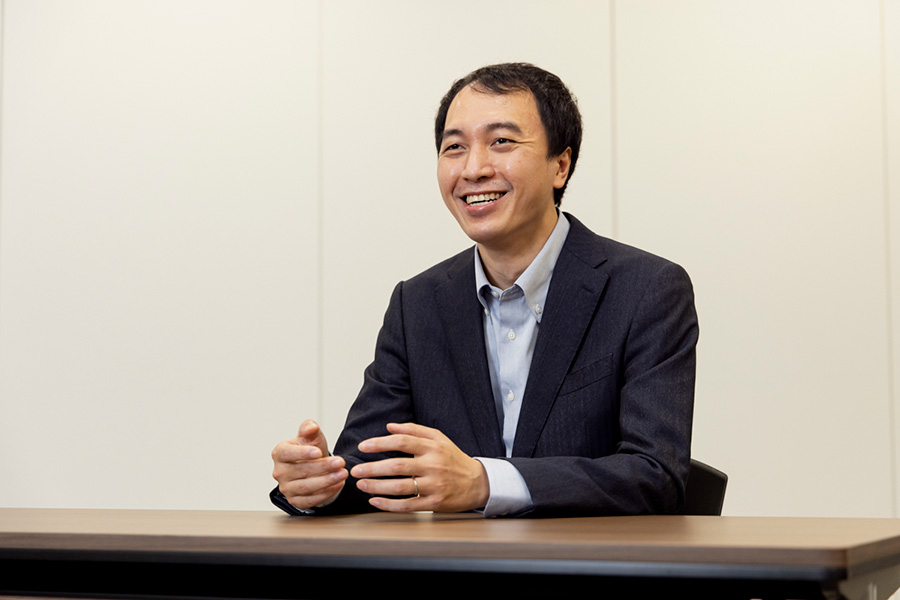
Zhang Xing Hui
Nationality: China Likes cars and watching F1 races. On his days off, he cherishes spending time with his family, such as helping his second grade and fourth grade elementary school children with their studies.
Learn about Our Other ESG Initiatives


- Top
- Sustainability
- Social
- Diversity, Equity & Inclusion
- Global Talent
- Dialogue between the President and Foreign National Employees